
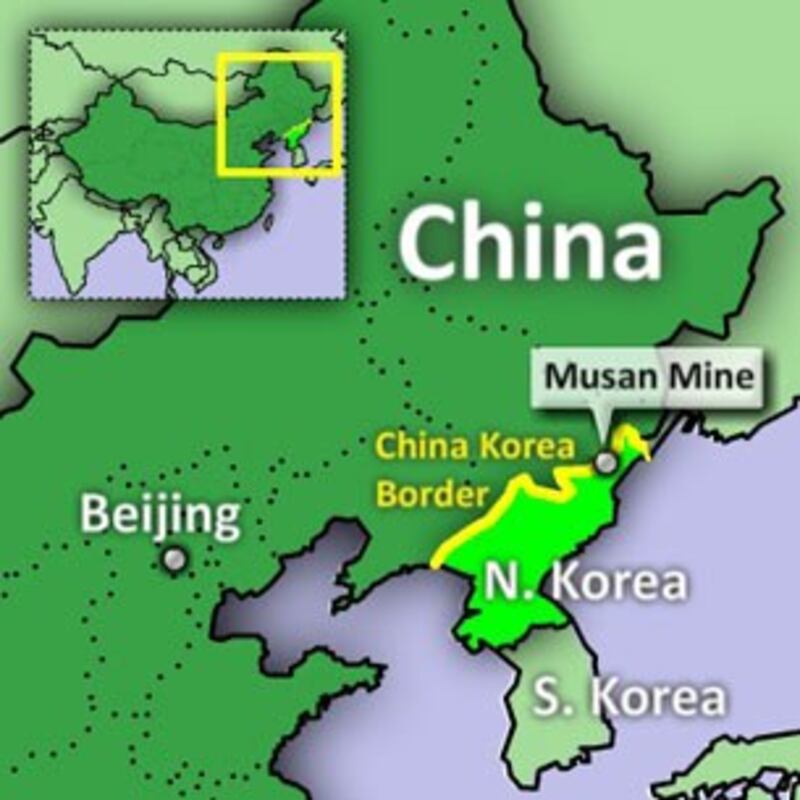
SEOUL—North Korea is pulling back from Chinese mining investments in an effort to independently develop its industry and use the profits to create a self-reliant economy, according to a well-informed North Korean defector.
But analysts say it is unlikely that North Korea will be able to lock China out completely, because it lacks the infrastructure and capital needed to develop the country’s vast mineral resources.
The defector, who said he had worked as the director of a state trading agency controlled by the military in a major North Korean city, refuted South Korean news reports that suggested China was taking control of North Korea’s underground natural resources.
“Such statements are exaggerated and different from the truth,” the defector, who uses the pseudonym Kim Ju Song, said in an interview.
Kim attended closed-door sessions with U.S. legislators and congressional staff in Washington on Wednesday.
Several South Korean news organizations, including the Yonhap news agency, recently reported that China has increased its investment in North Korea, established firm control over North Korea’s underground natural resources, and plans to utilize North Korea as its “natural resource base.”
The reports said Beijing had laid out a U.S. $1.2 billion investment plan for North Korean mine development and that Chinese firms had bid for the long-term rights to mine anthracite, iron ore, and molybdenum deposits in the country.
But Kim Ju Song called the reports “distorted,” adding that the North Korean regime is averse to such investments because its current objective is to create a “self-reliant” economy.
“With its own style of self-reliant national economy as the foundation, North Korea hopes to develop and employ its own technologies to extract and process its underground natural resources, prior to selling them on the world markets,” Kim said.
“However, under the current circumstances, simply selling those natural resources at a bargain price would not earn North Korea that much money,” he said.
Kim said that while North Korea will sell China minerals that it is unable to exploit due to technological limitations, “it would be inconceivable for the North Korean regime to cede its mines to China.”
Total mining independence ‘unlikely’
John Park, a senior research associate at the Washington-based United States Institute of Peace, said it is unlikely that North Korea will be able to effectively develop its mineral industry independent of China.
“It’s a chronic issue for the North Koreans to develop the transportation infrastructure that links up their mines,” Park said.
He added that much of North Korea suffers from shortages of the electricity required to develop profitable mines.
Park added that mining requires a “tremendous” amount of startup capital in order to purchase the equipment needed for mine development and mineral extraction.
“The Chinese state-owned enterprise model is so interesting is because of their government funding…These types of state-owned enterprise vehicles can actually sustain these early stage losses that private sector firms cannot,” Park said.
“From that functional capability standpoint the Chinese state-owned enterprise is one of the very, very few that can partner up [with North Korea],” he said.
Jennifer Lee, a researcher with the Peterson Institute for International Economics in Washington, said she doesn’t see North Korea “significantly” backing away from Chinese investment.
“But I can see why North Korea might want to lessen China’s near-monopoly state in that industry … with their Ju’che ideology and all,” Lee said, referring to the official state ideology of North Korea that roughly translates as “the spirit of self-reliance.”
Lee said she had heard reports that one of a group of North Korean delegates that visited New York last month was “eager to attract foreign investment other than from China.”
“I believe that they’re concerned that they are depending way too much on China alone,” she said.
But she acknowledged that North Korea lacks the infrastructure to refuse Chinese investment, particularly in light of international sanctions leveled against Pyongyang following testing of missiles and a nuclear weapon earlier this year.
Lee added that Beijing would be unwilling to allow North Korea to shrug off Chinese interests.
“They’re hungry for North Korean resources, especially because they can get [them] cheaper—being the only country with proper access to [North Korea],” she said.
'Wary of Chinese influence'
Andrei Lankov, a Seoul-based North Korea expert who works as a commentator for RFA, said that while talks of a “Chinese takeover” are not unfounded, they may be exaggerated.
“North Korean leaders … certainly would not welcome an excessive growth of Chinese influence inside North Korea,” he said.
He called North Korea’s leaders “ethnic nationalists of a rather extreme kind” who dislike foreign influence over their domestic affairs.
“Some contacts are taking place and some agreements have been concluded,” Lankov said.
“North Korean feels ambivalent about these contacts—it needs Chinese money, but is wary of Chinese influence,” he said.
Park called Chinese premier Wen Jiabao’s October visit to the North Korean capital Pyongyang “the culmination of a Chinese process to rebuild the bilateral relationship” between the two countries, noting that Wen had presented a comprehensive package of suggested partnerships to North Korea’s leadership.
“But with all things related to North Korea, it’s up to North Korea if they want to accept it or what portions of it they want to accept,” Park said.
“North Korea does have a record of renegotiating, which has definitely scared off other foreign investors in the past,” he said.
Lee added that even if North Korea decides to lessen China’s impact on its mining industry, such a decision would not involve a significant break with its northern neighbor.
“It would probably go towards the diversification route, trying to attract other foreign investors and possibly replacing some of the Chinese investment in the long run.”
She said North Korea now thinks of its mining industry as a “cash cow” and is working towards making it more attractive to foreign investors through development and a crackdown on corruption.
Original reporting by Song-wu Park for RFA’s Korean service. Acting Korean service director: Bong Park. Translated by Grigore Scarlatoiu. Written for the Web in English with additional reporting by Joshua Lipes. Edited by Dan Southerland.