
UPDATED at 8:37 A.M. ET on 03-24-2026
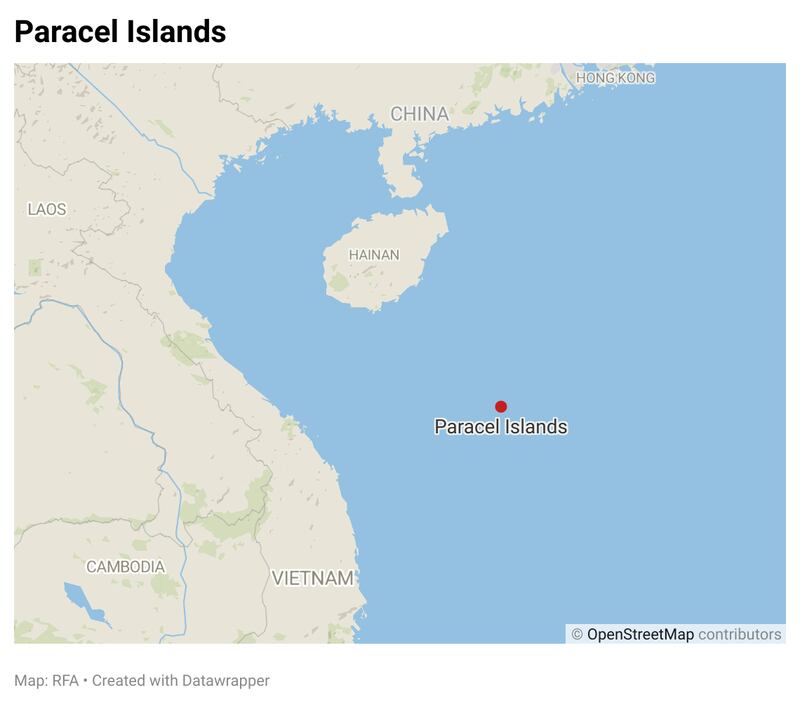
Vietnam has condemned China’s land reclamation activities at Antelope reef in the disputed Paracel Islands, following reports of accelerated dredging, landfill and construction operations there that, according to a U.S.-based think tank, could make it “China’s largest feature” in the South China Sea.
“Any foreign activities conducted in Hoang Sa, including Hai Sam reef, without Vietnam’s permission are completely illegal and invalid,” Vietnamese foreign ministry spokeswoman Pham Thu Hang said on Saturday, referring to the archipelago and the reef claimed by Hanoi and Beijing, as well as Taiwan, by their Vietnamese names. “Vietnam resolutely opposes such activities.”
Last week, the Asia Maritime Transparency Initiative, or AMTI, a project of the Center for Strategic and International Studies, or CSIS, in Washington, published an analysis of satellite imagery that said vast land reclamation efforts underway at Antelope Reef over the past month could make the reef suitable to construct a 9,000-foot (2700-meter) runway.
According to new @AsiaMTI analysis, Antelope Reef is set to become China’s largest feature in the Paracels and potentially in the entire South China Sea.
— CSIS (@CSIS) March 20, 2026
Read more: https://t.co/PT2ZYGKIoe pic.twitter.com/tw4YmeofVq
Beijing has constructed several airstrips of that size on other islands in the South China Sea including in the Spratly Islands, another disputed archipelago, the AMTI report said.
China’s foreign ministry during a press conference Monday asserted its position that the Paracels were Beijing’s territory.
“Xisha Qundao is China’s inherent territory, over which there is no dispute,” the ministry’s spokesperson Lin Jian said, referring to the archipelago by its name in Mandarin Chinese. “Necessary construction on our own territory is aimed at improving living and working conditions on the islands and growing the local economy.”
Territorial flashpoint
Though sovereignty over the Paracels is disputed, China took effective control of the archipelago after a 1974 naval clash with South Vietnam, which lost the Vietnam War to North Vietnam the following year.
The island chain is now one of several flashpoints in the South China Sea, where multiple countries assert overlapping territorial and maritime claims.



Media reports in early 2026 highlighted new Chinese dredging and landfill activity at Antelope Reef. Previously it had been one of China’s smallest outposts in the area.
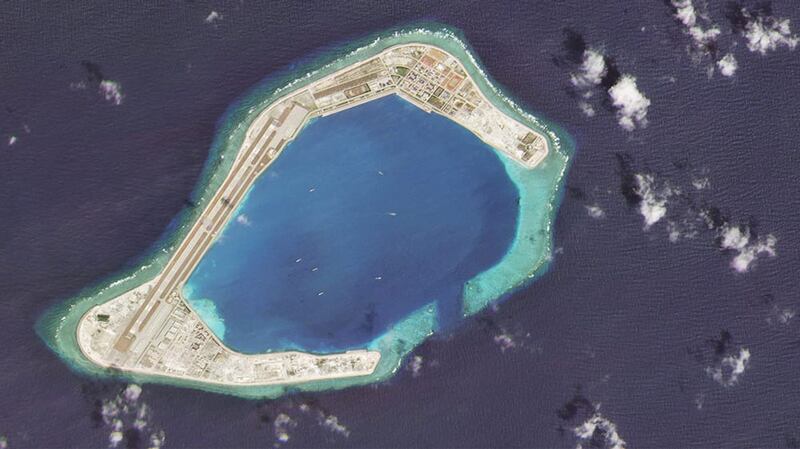
Beijing began major dredging there in October 2025 and has started what appears to be preliminary construction for an airstrip in recent weeks, including more than 50 small grey-roofed structures and a helipad near the lagoon entrance, as well as foundations for larger buildings and several jetties, the report said.
AMTI estimated that the reclaimed land at Antelope Reef measures roughly 1,490 acres (6.02 square kilometers), close to the 1,504 acres (6.09 square kilometers) of Mischief Reef, China’s largest outpost in the South China Sea. By comparison, Woody Island – the largest Chinese-held feature in the Paracels – measures about 890 acres (3.60 square kilometers).
“If construction proceeds at the pace seen in satellite imagery, Antelope Reef is set to become China’s largest feature in the Paracels and potentially in the entire South China Sea, equaling or even surpassing the size of Mischief Reef in the Spratlys,” the report said.
The lagoon at Antelope Reef could also support a larger maritime presence.
“This could allow more coastguard along with large numbers of maritime militia to maintain a presence at the reef, as has been common in recent years at Mischief Reef,” AMTI said.
Antelope reef is located about 162 nautical miles (300 kilometers) from Sanya Port in China’s Hainan province and 216 nautical miles (400 kilometers) from Da Nang, Vietnam. Sanya is a major base for Chinese naval and air forces overseeing the South China Sea, underscoring the location’s strategic importance.
The Law of the Sea
China’s expansion of the reef does not necessarily bolster its claims to the Paracels from a legal perspective, according to Josue Raphael J. Cortez, the Faculty and Practicum Coordinator at the School of Diplomacy and Governance at De La Salle-College of Saint Benilde in the Philippines.
“This is because if we will be utilizing UNCLOS as the basis of a country’s maritime entitlements, the basis is and will always be the natural conditions of these features,” he told Radio Free Asia, referring to the United Nations Convention on the Law of the Sea.
Adopted in 1982 and in effect since 1994, UNCLOS is the primary international legal framework governing maritime rights. Because it heavily relies on “naturally formed” land features to define each country’s exclusive economic zone and territorial seas, artificial expansion does not automatically create new legal rights.
Cortez also said that regional reactions would be closely watched, particularly given the reef’s proximity to Vietnam.
“Given that the reef is proximate in Vietnam’s portion of the South China Sea, it will be an interesting opportunity for the region to have an idea of how such a move will be perceived,” he said.
The development also comes amid renewed tensions elsewhere in the South China Sea, particularly between China and the Philippines over competing sovereignty claims.
Manila recently rejected Beijing’s claims over disputed territory, including Scarborough Shoal, insisting the Philippines’ claims are grounded in international law. China, meanwhile, has pushed back against what it calls “misrepresentations” of its position.
The shoal is a triangular chain of reefs and lagoons located off the western coast of the Philippines which China has maintained control of since a standoff in 2012.
Manila continues to assert its rights under international law, including a 2016 arbitral ruling that found Beijing’s claims in much of the South China Sea have no legal basis.
Edited by Eugene Whong.
The story was updated to include the response from China’s foreign ministry.