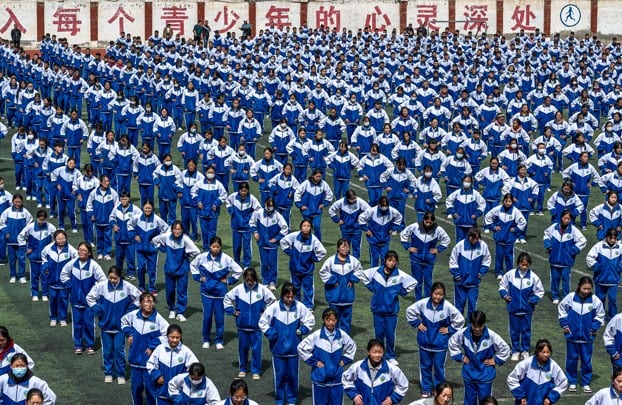
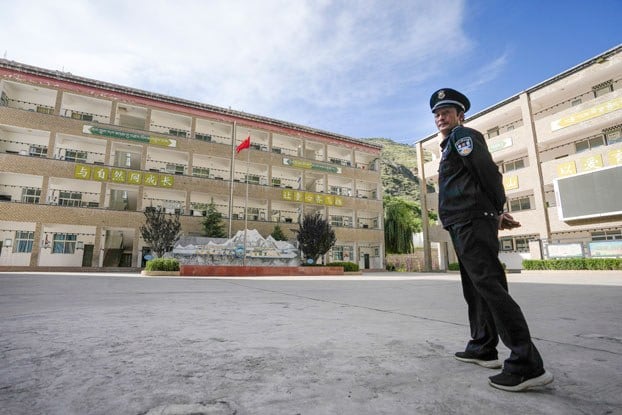
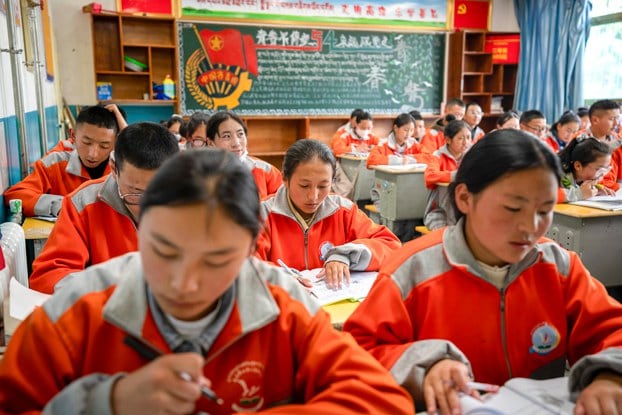
Chinese authorities have shut down three Tibetan schools in the Golog region of Qinghai province in recent months, leaving the fate of students and teachers unclear, according to sources inside Tibet.
The closures of Gangjong Grassland Girls’ School, Jasag Village Primary School and Golog Tadra Orphan School have raised concerns among Tibetans about the future of education that incorporates their language, cultural traditions and community life.
Tibetan sources who spoke to Radio Free Asia linked the closures to the Chinese government’s education policies and its promotion of the Ethnic Unity and Progress Law, which took effect on July 1, 2026. They said the shutdowns could further limit opportunities for Tibetan children to learn their mother tongue and cultural traditions.
The Chinese government has cited the high altitude of Golog and shortages of teachers and educational resources as reasons for establishing schools outside the region, saying the move would improve education. It remains unclear where students from the three closed schools will continue their studies.
Education department declines to comment
RFA contacted the education department of the Golog Tibetan Autonomous Prefecture by phone to seek details about the closures.
“We don’t know the details,” the person told RFA, saying the initial work had been carried out by the Machen County administration and that the county’s education department was responsible for the matter.
RFA also contacted the Machen County Education Department, which said it had “no authority to respond.”
Unclear future for students
Gangjong Grassland Girls’ School in Ragya Township, Machen County, was closed on Aug. 28, according to a source in Tibet who spoke to RFA on condition of anonymity for security reasons.
The school had about 450 students and 60 teachers at the time of its closure, the source said. The current situation of the students remains unclear.
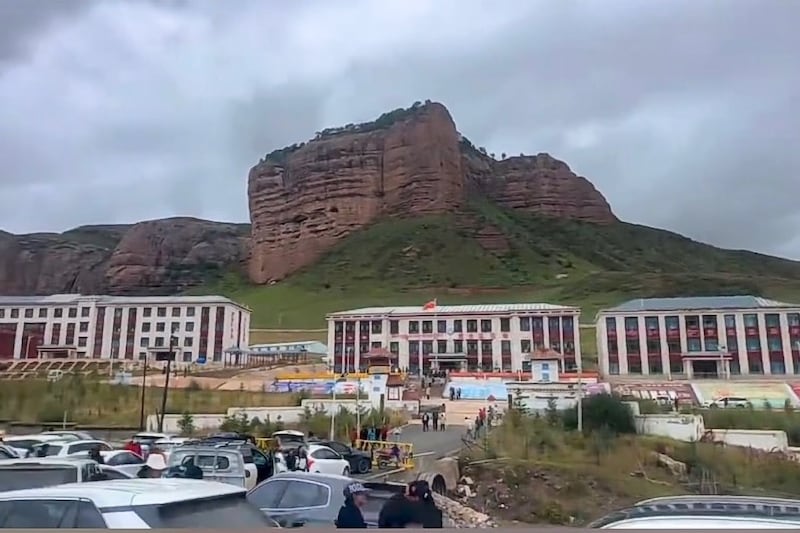
The source said the school had been made a government-affiliated institution, with its curriculum following the Chinese government’s education system while retaining some Tibetan-language instruction.
“Currently, the schools in the Golog region are conducting a strong patriotic reeducation campaign,” the source said, adding that Tibetans were afraid to share information because of government restrictions.
Jasag Village Primary School, which was established in 1995 with funds raised by local nomadic families and renamed Ragya Township Residential School No. 2 in 2008, was shut down in September, according to information obtained by RFA. Another source in Tibet told RFA that the situation of its students and teachers remained unclear.
“The Golog Education Department has put considerable pressure on the school’s teachers and shut down the school without providing any clear explanation,” the source said.
Golog Tadra Orphanage School was ordered to close this month, according to information obtained by RFA. Founded in 2005, it provided education and support to Tibetan orphans and disadvantaged children for two decades.
At an event marking the school’s 20th anniversary in 2025, principal Thupten Nyima of the Golog Tadra Orphan School, which provides K-12 education, said it was training more than 1,000 students. Some graduates had gone on to work in government positions and as teachers, he said.
Nyima addressed students and teachers in a recent video posted to social media, saying, “Don’t be sad, students and teachers. If we are bound by karma and fate, all the teachers and students gathered here will sing a song of joy together.”
It is unclear if Nyima’s remarks were made around the time the school was ordered to close.
Critics warn of cultural impact
Dr. Gyal Lo, a Tibetan educational sociologist, said the closures marked a significant change in the Chinese government’s education policy in Tibet.
“The Chinese government sees schools where Tibetans can organize themselves to learn and teach their own culture as a thorn in its side. That is why these schools are being abolished,” he told RFA.
“After Xi Jinping visited Qinghai, the school established by Jigme Gyaltsen was closed, and a new secondary school was built in the eastern part of Ziling,” he said.
Gyal Lo said the closures could distance children from Tibetan traditions and customs practiced in their communities and place them in state-run boarding schools where Chinese is the language of instruction.
“The first impact of the Chinese government’s school closures is that children are distanced from the Tibetan traditions and customs practiced in their homeland. Secondly, when these children enter state-run boarding schools, the entire curriculum is taught in Chinese and is under the government’s control,” he said.
He argued that the policies could affect the transmission of Tibetan identity across generations.
“The aim is to turn the entire Tibetan people into Chinese. This is not limited to a small area; it is a plan with far-reaching consequences,” Gyal Lo told RFA. “The ultimate goal is to turn the younger generation of Tibetans into Chinese through different methods and policies implemented in different regions.”
He also emphasized the role of families in preserving the Tibetan language.
“According to language education theory, a language cannot be passed on to the next generation without being taught within the family. The foundation for preserving the mother tongue and passing it on to the next generation must be laid at home,” he said.
Tenzin Lekshey, spokesperson for the Central Tibetan Administration in Dharamsala, India, said Tibetan schools and monasteries played an important role in preserving the community’s language, culture, traditions and identity.
“The Chinese government is doing all this out of fear. Tibetan schools and monasteries established inside Tibet aim to preserve and protect the rich Tibetan language, culture, traditions and identity. But the Chinese government views these institutions as a hindrance rather than a benefit,” he told RFA.
Ragya Geshe Lobsang Palden, a former political prisoner, said the new ethnic unity law had coincided with the closure of several Tibetan schools, some of which had already been brought under government control.
“These schools could not be shut down before because it was not legally appropriate to do so. Now, with the new Ethnic Unity Law in effect since July, many schools have been closing down,” he told RFA.
“However, many of these schools had already been converted into government-affiliated schools several years ago,” he added.
Dawa Tashi, a researcher at the Tibetan Centre for Human Rights and Democracy in Dharamsala, also linked the closures to the new law, saying it formalized policies that threatened Tibetan cultural and linguistic identity.
A former Tibetan political prisoner who visited Gangjong Grassland Girls’ School in 2006 said many of its graduates had gone on to serve their communities. The source requested anonymity for security reasons.
“I remember speaking with a teacher at the school in 2006 who told me that several teachers had been summoned by Chinese authorities. The teacher anticipated that the school might eventually be closed,” the source told RFA.
New government boarding schools
The closures come amid a broader restructuring of education in Golog, where authorities have promoted Chinese-language education and campaigns emphasizing national unity.
On Sept. 1, 2026 the Golog Education Department officially opened the newly established Golog Tsoshar Middle School in eastern Qinghai. According to Chinese state media, the school enrolled 1,200 students, including 1,090 Tibetans, many from farming and nomadic families.
Authorities have described the relocation of students from Golog to the lower-lying Tsoshar area as part of an effort to expand residential education in the highlands. It remains unclear whether students from Gangjong Grassland Girls’ School were transferred to the new institution.
Golog Ziling (Xining) Middle School, a state-run boarding school in Xining, was also opened on Sept. 1, 2019. According to official figures for 2024, it had 800 students, including 778 Tibetans, all from Golog. The school’s official introduction identifies fostering a shared sense of community among the Chinese nation as a central goal of its education.
In September 2026, the Golog prefecture government also launched a public language promotion week encouraging students to learn and use standard Chinese and emphasizing unity among the Chinese people.
Earlier school closures
The latest shutdowns follow several other closures of Tibetan educational institutions in Golog in recent years.
In July 2024, authorities closed Gangjong Sherig Norling School in Machen County after 30 years of operation. Founded by Jigme Gyaltsen in 1994, the institution had about 1,400 students and 58 teachers and staff.
The vocational school combined modern education with instruction in Tibetan language, culture, philosophy and religion. Reports in April 2025 indicated that authorities had permitted it to reopen as a vocational institution, although its curriculum was expected to change.
Dorjeten National Vocational School in Chikdril County (in Golog) was shut down on Dec. 12, 2025, affecting more than 1,300 students, according to reports. Hungkar Dorje Vocational Secondary School in Golog was also closed on June 24, 2026.
The latest closures have raised further questions about the future of Tibetan-language education in the region and whether students from the affected schools will continue to have opportunities to learn their language and cultural traditions.
Background: The three schools
Gangjong Grassland Girls’ School
Founded in 2005 by Tibetan educator Jigme Gyaltsen in Ragya Township, the school was established to provide education for girls, including those from nomadic communities. When it officially opened on Oct. 15, 2005, it had 203 students and 15 teachers. Its curriculum included Tibetan, Chinese and English, as well as mathematics, science, culture and sports.
Gyaltsen described his educational philosophy as follows: “The education of girls is the education of mothers, and the education of mothers is the foundation of human education.”
Jasag Village Primary School
Established in 1995 with funds raised by local nomadic families through the former Jasag Village Committee, the school served children from the surrounding community. It was renamed Ragya Township Residential School No. 2 in 2008 and closed in September 2026.
Golog Tadra Orphan School
Founded in 2005 by the late Dr. Tawo Lobsang Palden and his wife, Choenyi Lhamo, the school provided education, accommodation, food, clothing and health care to Tibetan orphans and disadvantaged children. Over two decades, it served thousands of children. Lhamo now lives in Germany.
Translated by Tenzin Dickyi and edited by Tawang for RFA Tibetan