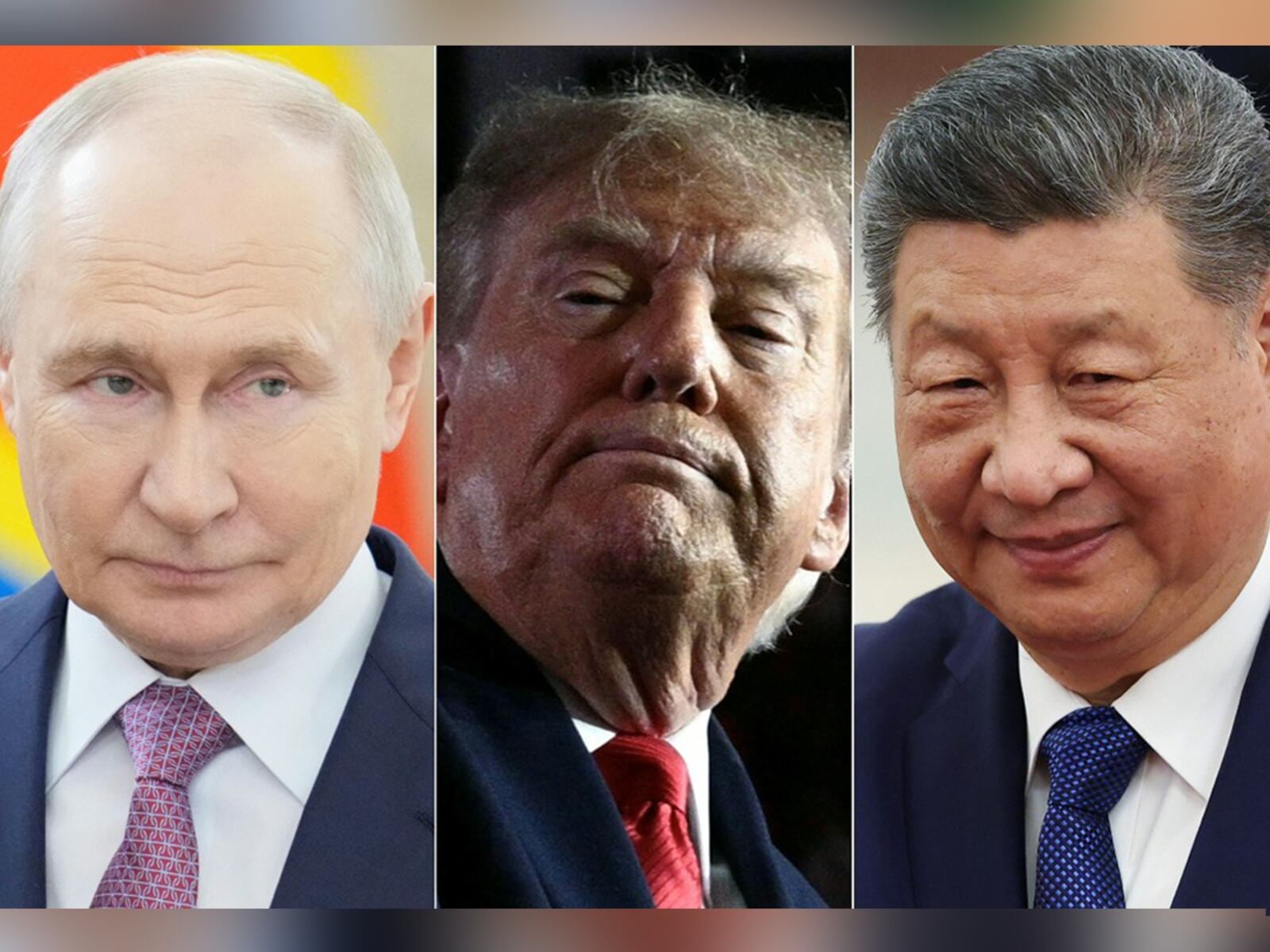
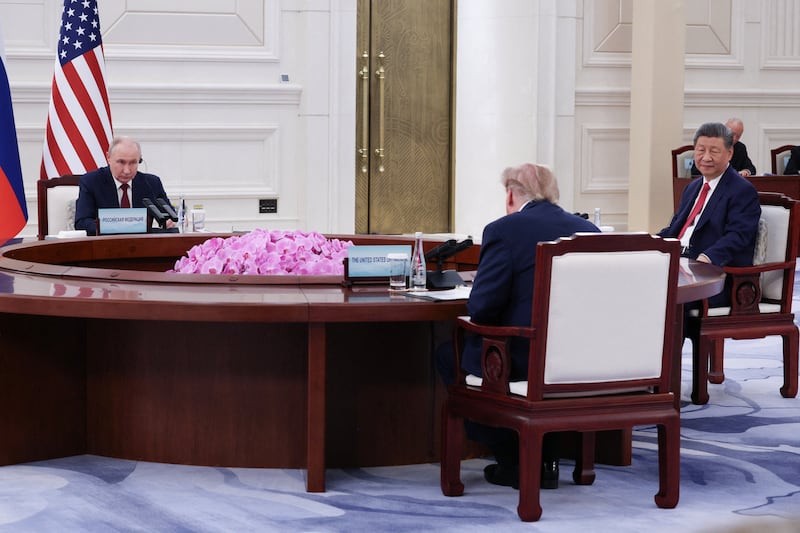
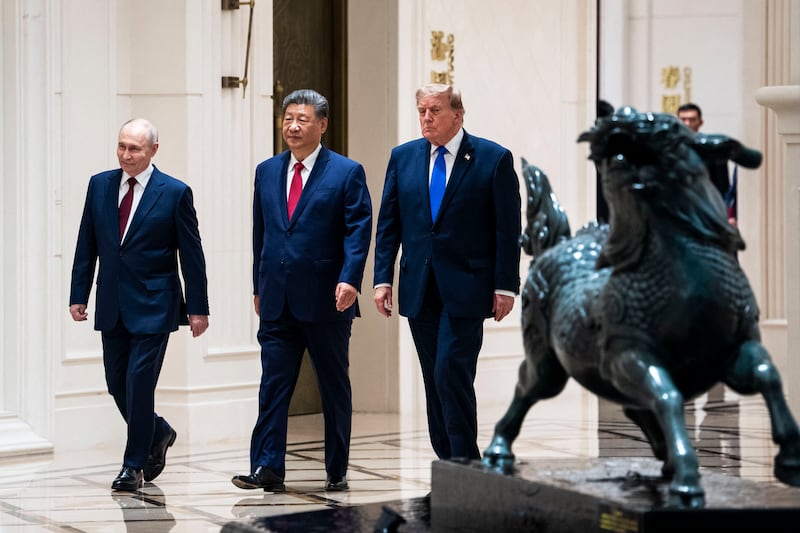
The leaders of the United States, China and Russia concluded their first-ever trilateral summit in Shenzhen on Thursday, with nuclear arms control and regional conflicts high on the agenda amid deepening geopolitical and technological competition among the world’s major powers.
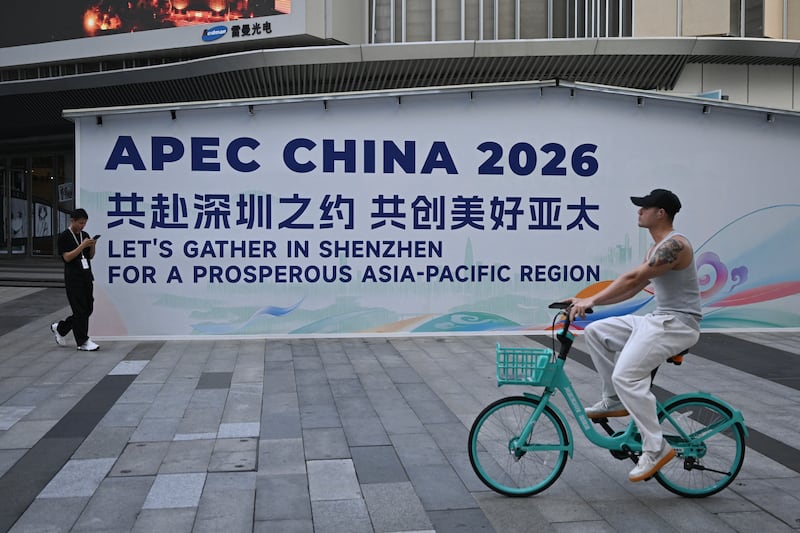
U.S. President Donald Trump met Chinese President Xi Jinping and Russian President Vladimir Putin for more than an hour on the sidelines of the Asia-Pacific Economic Cooperation (APEC) forum, describing the gathering as a historic diplomatic occasion.
“As the world’s three largest nuclear powers by far, the United States, Russia and China are uniquely positioned to discuss how to reduce the number of nuclear weapons on Earth and also to lessen the risk that those weapons will ever be used,” Trump said in his opening remarks.
Xi called for the prohibition and destruction of nuclear weapons and the establishment of a world free of them, according to Chinese state broadcaster CCTV.
The summit marked the first leader-level talks on nuclear arms control since New START expired in February. Its lapse ended the last remaining bilateral nuclear treaty between Washington and Moscow, raising concerns about an unrestricted arms race.
Trump has called for a new agreement that would bring Beijing into nuclear arms control negotiations. China, however, has long maintained that Washington and Moscow should substantially reduce their stockpiles before asking it to accept limitations on its comparatively smaller arsenal.
China is estimated to possess more than 600 nuclear warheads, while the United States and Russia hold more than 5,000 each.
“Once you have the nuclear weapons, it’s very hard not to have them,” Trump said. “So it’s not an easy thing to do, give them up.”
Xi also proposed regular high-level exchanges and the creation of a crisis communication mechanism among the three powers to help manage tensions.
No concrete agreement on nuclear arms control was immediately announced following the summit.
The White House released a statement that said the three leaders “reaffirmed that a nuclear war cannot be won and must never be fought.”
The statement also said that the three countries would hold dialogues on preventing the spread of nuclear weapons and minimizing nuclear risks.
Taiwan’s security concerns
Ahead of Thursday’s trilateral meeting, Taiwan’s government downplayed expectations that the island would feature prominently in discussions among the three leaders.
“From what we know, Taiwan is not the focus,” Mainland Affairs Council (MAC) spokesperson Liang Wen-chieh told a news briefing in Taipei.
Liang said the discussions were more likely to prioritize securing a ceasefire in Ukraine and addressing Iran’s nuclear program.
“Even if Taiwan is mentioned, it will be a relatively peripheral issue,” he said.
Liang also expressed doubts about whether the three leaders could reach substantive agreements given their competing interests and the limited time available for negotiations.
“The three parties want different things, and their priorities are also different,” he said.
Taiwan nevertheless featured in a separate bilateral meeting between Trump and Xi earlier on Thursday, their third face-to-face meeting this year.
Xi told Trump that Washington should “stick to doing the right thing” on Taiwan to avoid major setbacks in relations between the two countries, China’s official Xinhua News Agency reported.
According to Xinhua, Trump told Xi that the United States “does not support Taiwan independence.”
The White House had not released its own account of the bilateral meeting at the time of Xinhua’s report.
During the trilateral summit, Xi also called on major powers to respect each other’s sovereignty, territorial integrity and core interests, warning against crossing red lines on sensitive issues.
Taiwan, which joined APEC in 1991 under the name Chinese Taipei, is represented at this year’s summit by Acer founder and honorary chairman Stan Shih, appointed by President Lai Ching-te to attend on his behalf.
Competition over artificial intelligence
The summit took place against a backdrop of mounting technological rivalry between Washington and Beijing, particularly over artificial intelligence (AI) and access to advanced semiconductors.
Trump has held off on imposing tougher restrictions on China’s access to advanced chips used to develop AI models, indicating that additional measures could aggravate bilateral tensions.
Xi urged Washington and Moscow to work with Beijing to maintain stable global supply chains and called on the three powers to “abandon Cold War mentality, not pursue decoupling and breaking chains.”
Competition over emerging technologies has become a major point of friction between the world’s two largest economies, alongside disagreements over trade and access to strategically important raw materials.
U.S. officials have accused Beijing of failing to fully implement commitments made during a Trump-Xi meeting last year, including pledges to purchase more American agricultural products and ease export restrictions on rare earth minerals used in electronics manufacturing.
A trade truce reached last year following successive tariff increases is due to expire on Jan. 10, 2027, adding another source of uncertainty to bilateral relations.
Edited by Eugene Whong.