
Read a version of this story in Korean
[Editor's Note] Radio Free Asia recently obtained internal documents, on-site videos, and photos from a North Korean overseas dispatch company that has sent laborers to China. Most of these materials were produced in the first half of 2025 and include contracts between North Korean and Chinese companies as well as details on the “application of employee living expenses,” which is how their wages are classified. RFA has also secured a significant number of videos and photos of North Korean workers employed at Chinese companies. RFA’s analysis of these materials presents a harsh reality for these workers that includes stolen pay and poor working conditions. To protect sources, some parts of the documents will be redacted, and only selected scenes from the videos will be released as still images.
The North Korean government confiscates around 90% of the wages earned by workers it dispatches to China, internal documents obtained by Radio Free Asia revealed.
Sources in China have previously told RFA that the North Korean companies that handle the dispatched workers in China collect their wages and forward most of the money to Pyongyang in the form of “loyalty funds,” extra support for state projects, and other fees.
According to the sources, a Chinese company will typically pay around 2,500 to 4,000 yuan (about US$375 to $600) per month for every North Korean dispatched worker, but the worker will actually only receive 100 to 300 yuan ($15 to $45).
But the documents – which were made in early 2025 – include contracts, ledgers and other accounting records and are the first known instance where the deductions for the state are confirmed in print.
One contract, between a clothing company in China’s Liaoning province and a North Korean worker dispatch agency shows the details regarding the workers’ wages:
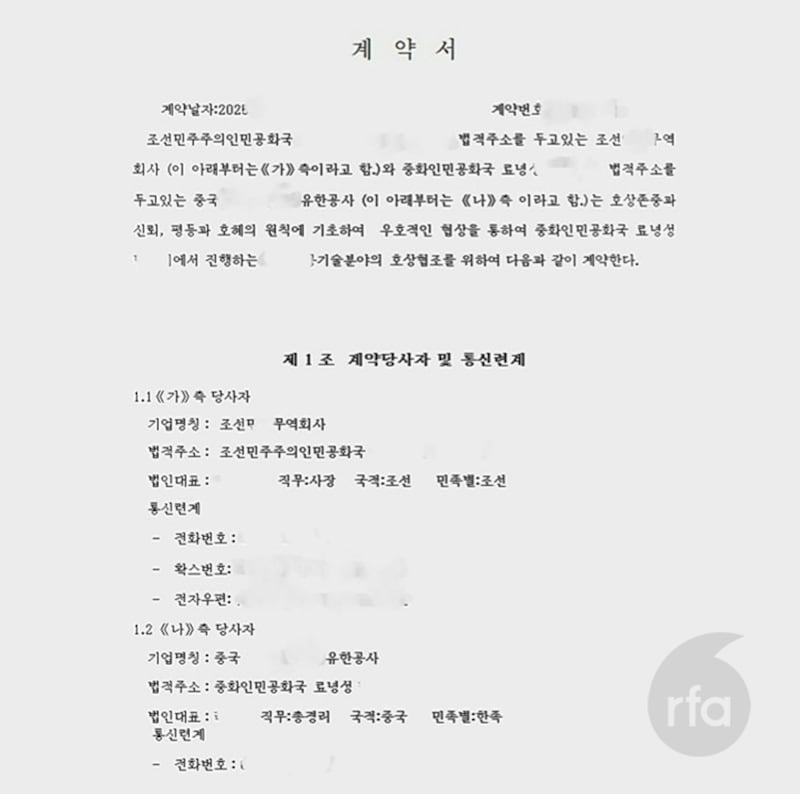
According to Article 4, Clause 1 of the contract, the Chinese company will pay the dispatch company a monthly rate of 5,000 yuan for managers; 4,000 yuan for “assistants” – actually a worker surveillance agent dispatched by Pyongyang’s State Security Ministry; and 4,000 yuan for interpreters. The Chinese company will pay 3,500 yuan for “skilled workers” – the majority of the dispatched personnel, and this includes meal expenses. Clause 2 states that during a two-month training period, the Chinese company will pay 1,500 yuan per North Korean worker.
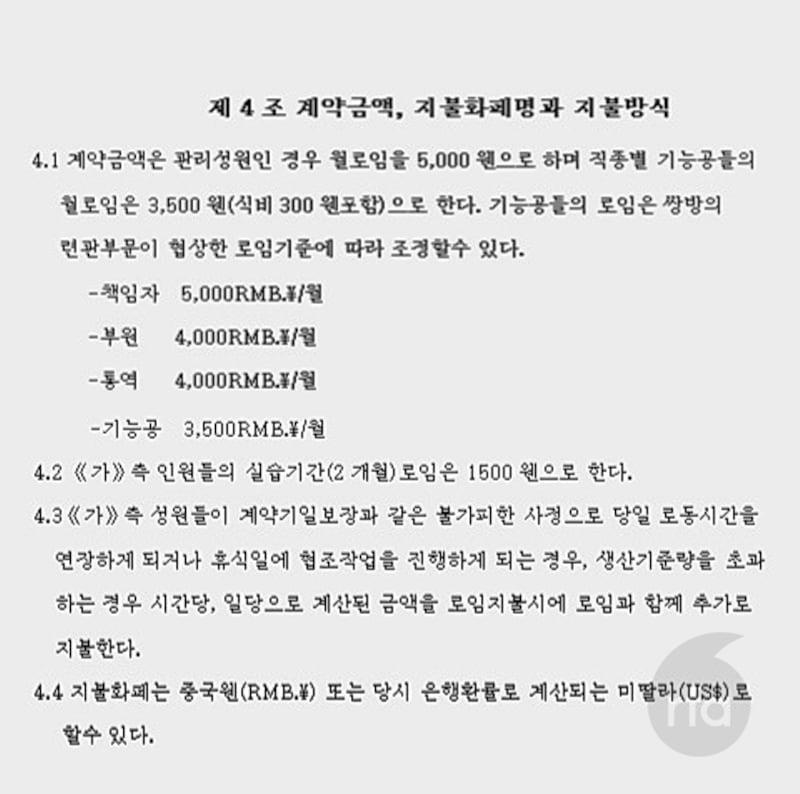
On paper, it appears that each North Korean worker could expect to be paid a wage of 3,500 yuan (about $525) per month. This would be a hefty sum, enough to buy close to a metric ton (2,200 pounds) of rice in a North Korean marketplace, at a time when most domestic North Korean workers can’t even afford a single kilogram with their monthly salaries.
But an examination of other documents shows a discrepancy between what the contract stipulates and what the manager of the dispatched workers recorded. The dispatched companies classify the workers’ wages as “living expenses.” A “Living Expense Analysis Table,” that the manager sent to the North Korean headquarters shows that the company received only 2,600 yuan per worker per month. The discrepancy is not accounted for in the documents.
It is highly likely that the manager in this case was setting aside slush funds with the approval of the headquarters’ president, Ri Jong Ho, a former high-ranking official at an organization under Office 39, the clandestine group formed in the 1970s to manage slush funds for the North Korean leadership, told RFA.
“The president of the headquarters in Pyongyang must provide imported goods and foreign currency demanded daily by officials of powerful institutions,” he said. “It is highly probable that he asks the dispatched manager for help each time.”
Ri explained that the manager has to come up with the money somehow and the only way to do this is to dip into the wages.
“Discrepancies between the contracted amount and the reported amount are a phenomenon that frequently occurs,” he said.
The living expenses table shows that the remaining 2,600 yuan is further reduced before the workers get their share: 1,000 for “state contributions,” 300 for “food expenses,” 500 for “maintenance costs” for the managers’ Chinese office, and 300 for “management expenses” for the Pyongyang headquarters.
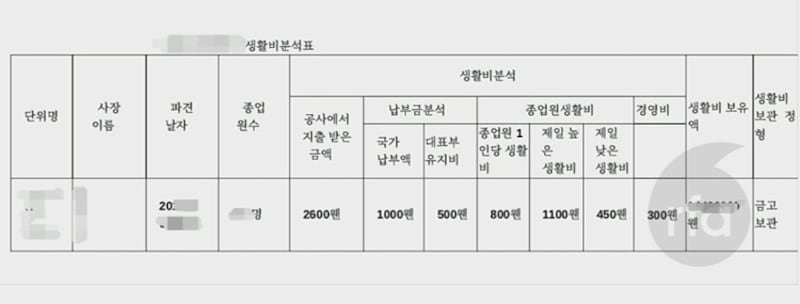
After calculating these items, the North Korean official reported to headquarters that living expenses per employee were paid at an average of 800 yuan, a maximum of 1,100 yuan, and a minimum of 450 yuan. However, after each itemized deduction, the remaining amount for the workers is only 500 yuan, less than the reported average wage of 800 yuan. It is therefore highly likely that the actual wages paid to workers are lower than the listed “average amount” and closer to the “minimum amount.”
If the average pay is the remaining 500 yuan, that represents an 86% total deduction from the contracted wage.
Reported wages vs. reality
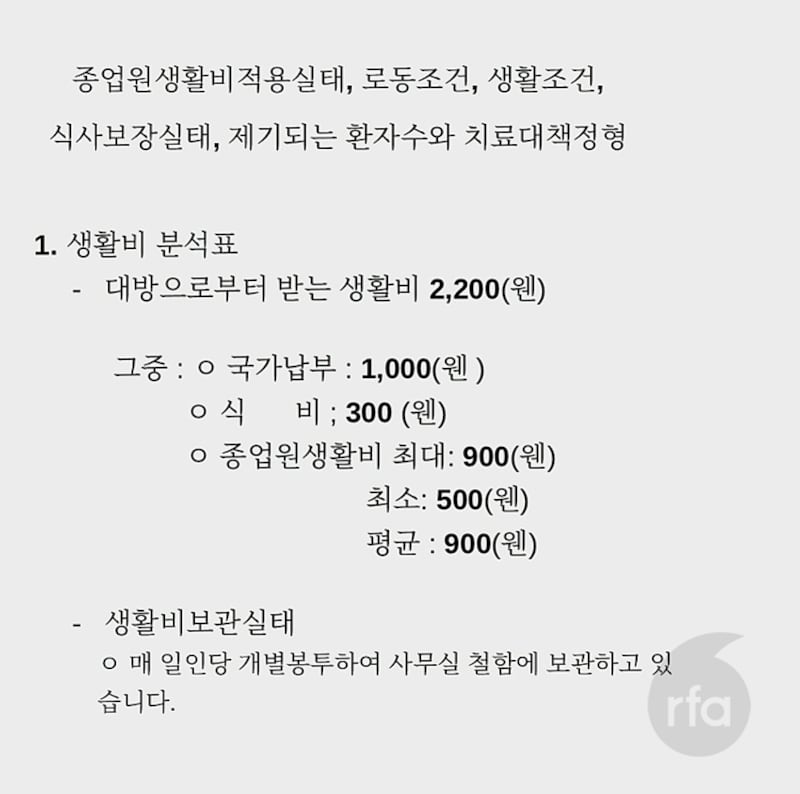
Similar wage deductions were observed in communications between managers of North Korean workers and the Pyongyang headquarters. According to another contract obtained by RFA between a food company in Liaoning and a North Korean dispatching company, the wage for a skilled worker is 4,000 yuan, slightly higher than the 3,500 yuan paid by the clothing company.
However, the dispatching company reported that it received 2,200 yuan per worker. Just as before, the discrepancy is not accounted for in any documentation. From the base of 2,200 yuan, 1,000 was deducted for “state contribution,” and 300 for food expenses, leaving 900 for the workers. The average pay was listed at a maximum of 900 yuan and a minimum of 500.
The Multinational Sanctions Monitoring Team, or MSMT, an intergovernmental organization that helps U.N. member states enforce sanctions on North Korea, estimated the number of North Korean workers in China to be between 20,000 and 70,000 in a report published Sept. 16.
Assuming that each worker pays a state contribution of roughly 1,000 yuan, the amount collected by the North Korean authorities reaches between 20 million and 70 million yuan ($3 million to $10.5 million).
Even considering the paltry remnants of their salary that they should be receiving, that can be reduced even further when the government requires donations or subsidies for state projects. The expense ledger submitted by a North Korean manager dispatched to a Chinese clothing company which covered the six years between 2019 and 2025, detailed these mandatory donations.
According to the ledger, donations and grants are broadly divided into three types. The first is the “Kim Il Sung and Kim Jong Il Fund,” named after the North Korean leader Kim Jong Un’s father and grandfather, who are also his predecessors. The fund is nominally for the upkeep of the Kumsusan Palace of the Sun in Pyongyang – a mausoleum where the former leaders are enshrined – and other projects related to commemorating their lives.
The amount of donations to this fund varied over the years, starting with the workers donating a collective 3,000 yuan in 2019, climbing to 11,500 in 2020, then dropping into the 3,000 to 10,000 range until hitting 16,000 in 2024. The ledger showed that in the first four months of 2025, they had already donated 16,000 yuan.
The second listed type of deduction is funding for idolization projects. The manager reported to headquarters the amount paid as support for “proceeding with the work to forever hold the Great Marshals in high esteem as the Sun of Juche,” with the sun referring to the poetic representation of national founder Kim Il Sung, who created the country’s founding Juche ideology of self-reliance.
According to the document, in 2019, the company as a whole donated 3,000 yuan to the North Korean consulate’s flower exhibition featuring the Kimjongilia, a begonia named after the late former leader on the occasion of his 46th birthday in 1988, prior to his ascension following the death of his father in 1994.
The workers also donated in 2024 a combined US$7,000 for the Samjiyon Project, Kim Jong Un’s ambitious plan to construct a modern socialist paradise at the foot of Mount Paektu, the tallest mountain in Korea and the setting of many of the ancient founding myths of the Korean people, and the modern myths related to the birth of Kim Jong Il.
The company also donated 5,000 yuan for upkeep at the Sino-Korean Friendship Exhibition, a museum in North Korea dedicated to friendly relations with China.
The third and final item on the ledger is for operating expenses at the North Korean consulate and support funds for the fatherland spent under the pretext of “patriotic activity projects.” Collectively 200,000 to 300,000 yuan was donated annually for these. In particular, in 2023 and 2024, 20,000 yuan each was spent on “military industry support” projects under the consulate support category.
“Cash is provided to the Ministry of Military Industry to purchase materials necessary for the modernization of military factories,” Ri said. “This is in accordance with Kim Jong Un’s orders and directives.”
Fatherland support projects
Between 150,000 and 260,000 yuan were collectively donated annually on projects supporting the fatherland, accounting for the largest share among the donation categories.
Specifically, 50,000 yuan was contributed in July 2020 for the construction of the Pyongyang General Hospital, 170,000 yuan in 2021 for COVID-19 prevention, 50,000 yuan in 2024 for agriculture and housing improvement, and 60,000 yuan for flood damage recovery.
This demonstrates that the costs of the new national tasks and policy projects proposed by the North Korean authorities are being significantly covered by the wages of workers employed by overseas dispatch companies.
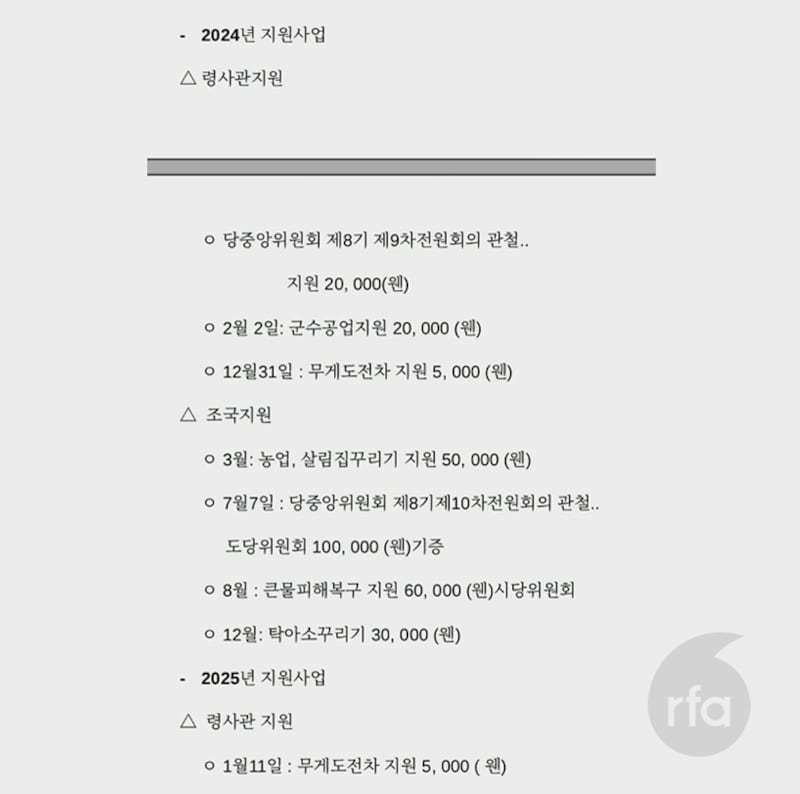
Looking at the year 2024 alone, the total amount spent by this company under various pretexts reached 352,000 yuan ($52,000). This strongly implies that workers’ wages are used as a source of funding for the company’s various contributions and support projects.
Sources in China told RFA that managers of dispatched workers are evaluated based on how much they can contribute to fatherland improvement funds, so there are incentives to force the workers to donate from the tiny amounts they are paid.
“They make one or two people contribute large amounts of funds or subsidies, citing them as models of loyalty to compel other workers to follow suit, or assign workers who pay more to work easier jobs,” a source in China who requested anonymity for security reasons, told RFA.
Official kickbacks and various donations are not the only channels through which wages are siphoned off. Managers and executives also embezzle funds, sources said. This is done by making deductions for cosmetics, clothing, toilet paper and food at a significant markup.
Dispatch agencies restrict external access out of fear that the workers might escape, leaving them with no choice but to request and purchase necessary supplies from the company, forcing them to pay whatever price the manager sets for these.
The reason North Korean workers’ wages can be reduced so easily appears to be due to the method of storing cash in safes.
“Living expenses are collected in individual envelopes for each person and stored in a safe in the office,” a manager at a North Korean dispatch company in China reported to the Pyongyang headquarters.
According to sources, workers merely record their monthly living expenses and costs for daily necessities in the company ledger. They do not handle the cash directly. Wages are settled and received all at once upon their return home. Since the cash is kept in a company safe inaccessible to the workers, the amount they receive depends on the company’s ledger, which the managers can edit at any moment.
Ultimately, after all the various deductions and forced donations, the actual amount received by each worker is around 100 to 300 yuan ($15 to $45) per month. The source told RFA that there are many workers who did not even receive 10,000 yuan ($1,500) when they returned home, despite having worked in China for nearly 10 years.
Fraction of wages paid out upon return
Although their nominal salaries are many times what they could be earning in government-assigned jobs back home, MSMT’s report explained that the North Korean dispatched workers often return home with debt.
“The DPRK government confiscates 80-90% of wages earned by North Korean labourers. In some cases, the confiscated amount exceeds their actual earnings, leaving North Korean overseas labourers indebted to the DPRK government.”
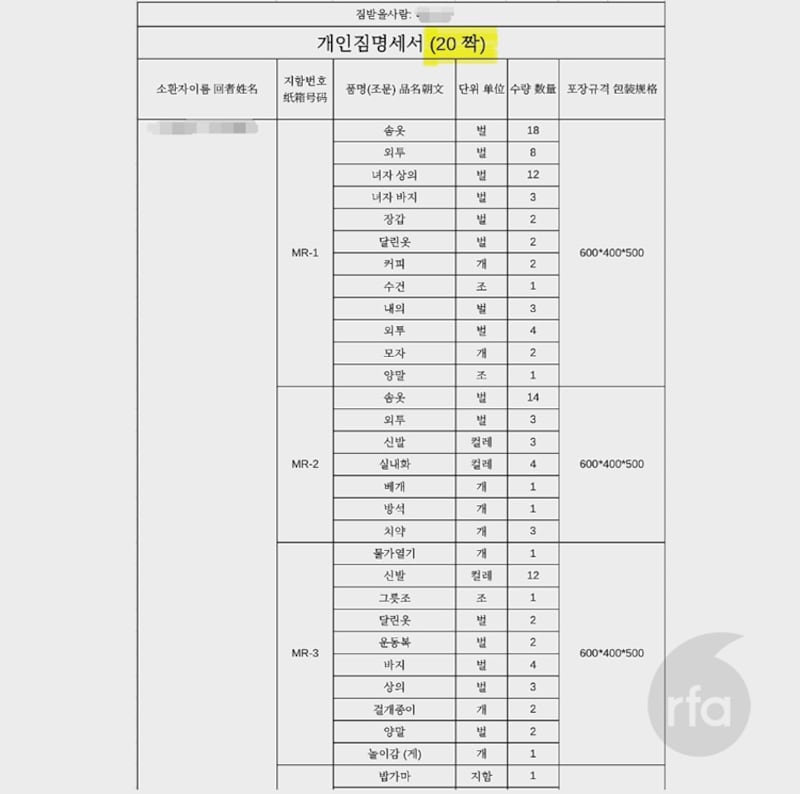
Due to the anxiety that they might not receive proper wage settlements upon returning home, some workers prepare for this “wage disappearance” by buying up daily necessities from China and reselling them in North Korea. One worker even declared “20 bags weighing 50 kilograms each” as the luggage he was to take back.
“The Multinational Sanctions Monitoring Team report identified the Workers’ Party’s Office 39 and others as organizations involved in the dispatch of overseas workers,” said Ri. “Workers whose contracts state a salary of 3,500 yuan actually receive a maximum of 300 yuan, while the rest goes to Pyongyang under the names of state contributions and various donations to make up Kim Jong Un’s slush funds.”
Edited by Yi Yongin in Korean and Eugene Whong in English.


