Read a version of this story in Uyghur
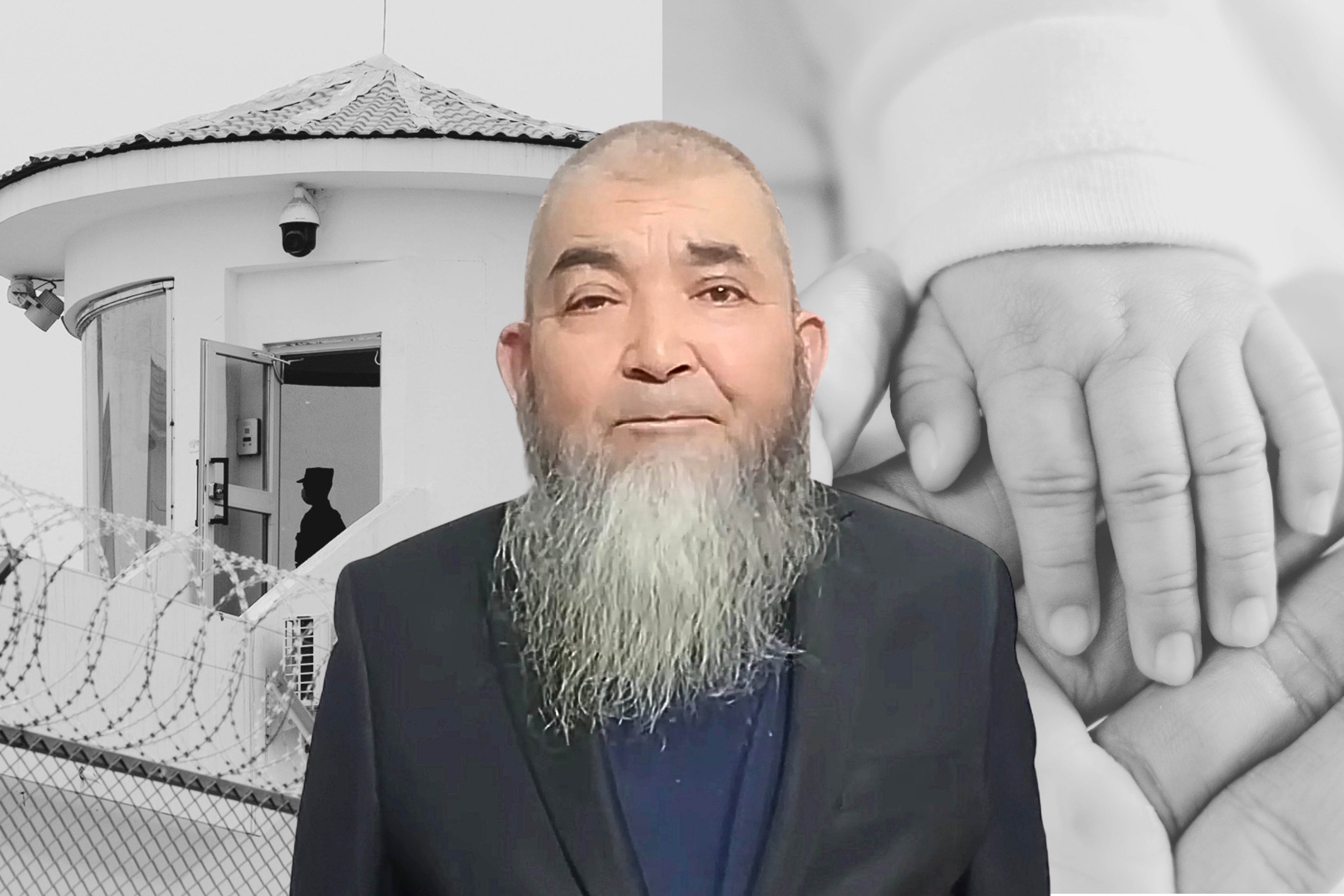
Chinese authorities in 2018 lied to the family of a Uyghur bus driver who died in their custody, an investigation by Radio Free Asia has revealed.
Authorities told the family of Yasinjan Toxti, who had been detained in a “re-education” facility on suspicion of “religious radicalism,” that he had died in a car accident.
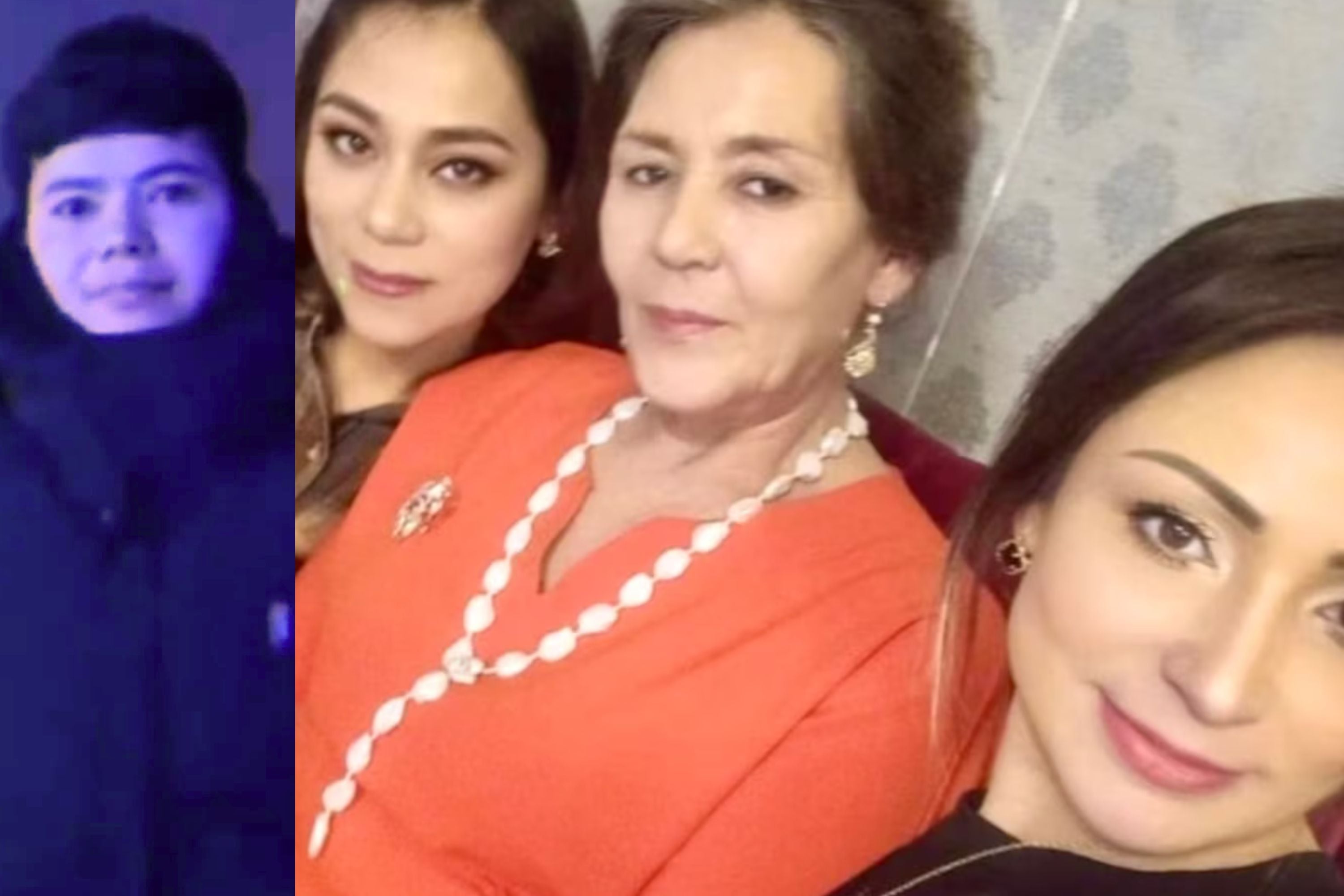
Yasinjan’s sister Reyhangul told RFA that the details did not add up. A resident of Belgium, Reyhangul discussed the moment in 2018 when her younger sister in the Uyghur region told her of her brother’s death.
“How could someone held in ‘re-education’ die in a traffic accident?” she recalled asking. She said her sister replied, “That is what the police told us. We have to accept that explanation. Under the current circumstances, we cannot ask any further questions about it.”
2018 was the height of China’s Uyghur internment campaign aimed at “curbing terrorism” where an estimated 1.8 million Uyghurs were put in detainment facilities claimed by authorities to be vocational training centers. The U.S. in 2020 classified Beijing’s actions in the Uyghur region as a genocide.
Inconsistencies uncovered
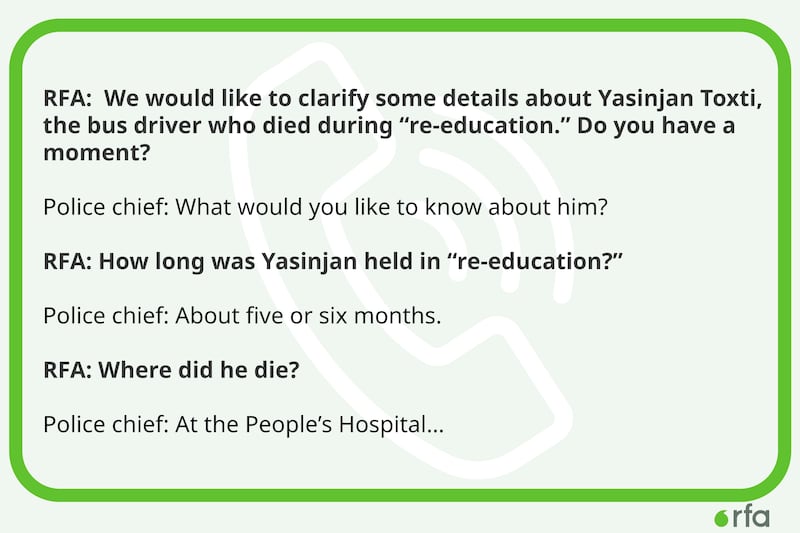
In an attempt to gain more clarity on the circumstances of Yasinjan’s death, RFA this month telephoned the Qartal Bazaar police station in Aksu, an oasis city in the Uyghur region, where Yasinjan lived and worked.
Two separate police personnel shared information that conflicted with what authorities told Reyhangul’s family in 2018.
The chief of the police station was the first to answer RFA’s questions.
A police officer on duty provided further details.
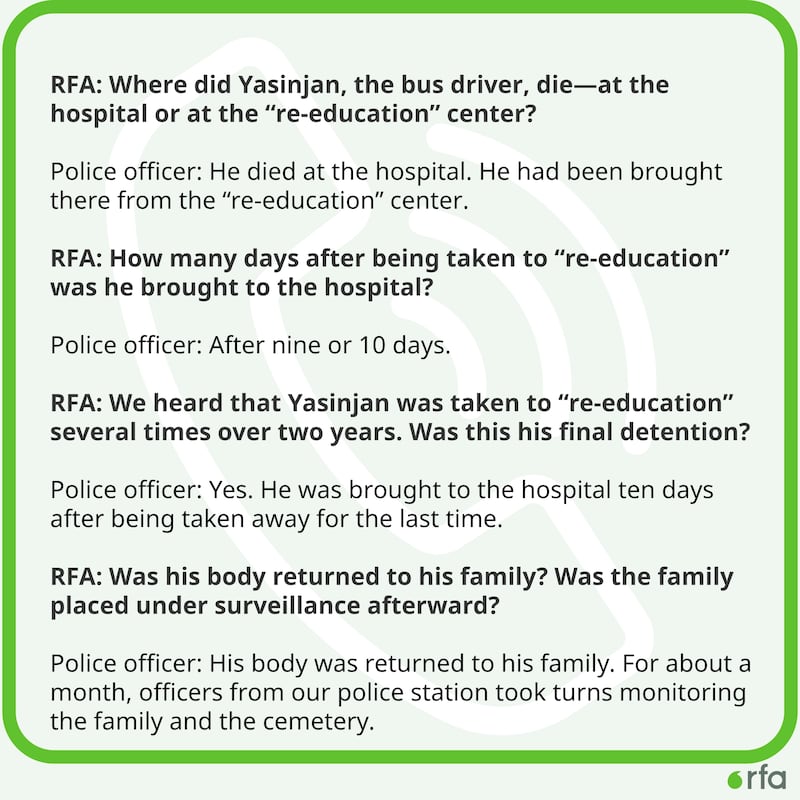
In assessing that Yasinjan had been in detention for “five or six months,” the police chief may have been referring to his cumulative time in re-education across multiple sentences, and the police officer who said he was taken to the hospital after “nine or 10 days” may have been referring to the length of time into his latest sentence. RFA was unable to confirm what either expression of time meant exactly.
Educational pursuits
Yasinjan was born in 1980 in Aksu and lived there his entire life. Having received only a primary school education himself, Yasinjan saw the importance of education and sent his five-year-old son, Hebibulla Yasin, to study in Egypt. His sister was already living in Egypt overseeing her own children’s education, and agreed to be Hebibulla’s caretaker there.
Sending children abroad for educational purposes was at the time common for many Uyghur families, because China had been expanding its policy of “bilingual education,” – which in practice was replacing the Uyghur language with Mandarin Chinese for most classes.
Many Uyghur parents viewed this as accelerating assimilation, and feared their children would lose their Uyghur cultural and religious identity. Egypt, which had a strong reputation for Islamic education, and relatively low living costs, was a natural choice for families wishing to preserve their culture.
Before 2017, more than 5,000 Uyghurs were living in Egypt, but mass arrests by the Chinese government under the “Strike Hard Campaign Against Violent Terrorism” intensified the next year. Arrests often targeted Uyghurs with family members abroad, especially in “sensitive” Muslim majority countries like Turkey and Egypt.
Arousing suspicion
Because his son was in Egypt, Yasinjan was detained several times between 2016 and 2018 on suspicion of “religious radicalism” and subjected to short periods of “re-education,” according to Reyhangul. Authorities were able to compel Yasinjan to bring Hebibulla home, but even after his son returned, Yasinjan remained under suspicion.
Yasinjan was in custody four separate times between 2016 and 2018. His latest detention was for stopping the bus in the middle of his route to allow Muslim passengers to observe the call to prayer.
It was during this latest detention that he died – not of a traffic accident as Reyhangul said authorities previously claimed – but after arriving in a “re-education camp” as confirmed by police in RFA’s investigation.
Years after Yasinjan’s death, while Reyhangul was searching for more information, she learned that other members of her family had been detained – her sister, who had told her about their brother’s death, for “leaking state secrets,” and her mother, who had traveled to Turkey, for “visiting a sensitive country.”
Still, Reyhangul does not know where they are detained, nor the length of their sentences, she said.
Edited by Eugene Whong and Charlie Dharapak.