Read a version of this story in Korean
A North Korean video warns soldiers that they could be punished - and they should be executed -for watching foreign media, a recording obtained exclusively by Radio Free Asia reveals.
A female narrator with a booming voice denounces soldiers for not resisting the temptation to watch “impure recordings” like South Korean TV shows and Hollywood films.
The footage obtained by RFA is a recording of a screen showing the video. It is believed to have been produced in 2023 and is still in use in soldiers’ ideological training sessions, sources inside the country told RFA on condition of anonymity for security reasons.
“I strongly demand, on behalf of all military personnel, the summary execution of those who have become thoroughly steeped in the rotten imperialist ideology, culture and way of life,” the narrator says. She calls for the “relentless pursuit and capture” of those who watch foreign media so that they can be “subjected to merciless punishment.”
The educational video presents the cautionary tales of at least two military personnel who were caught watching foreign media, detailing how they were punished.
Media matters
North Korea routinely punishes citizens for watching foreign media or listening to foreign music which is typically smuggled into the country and distributed on thumb drives and easily concealable micro SD cards.
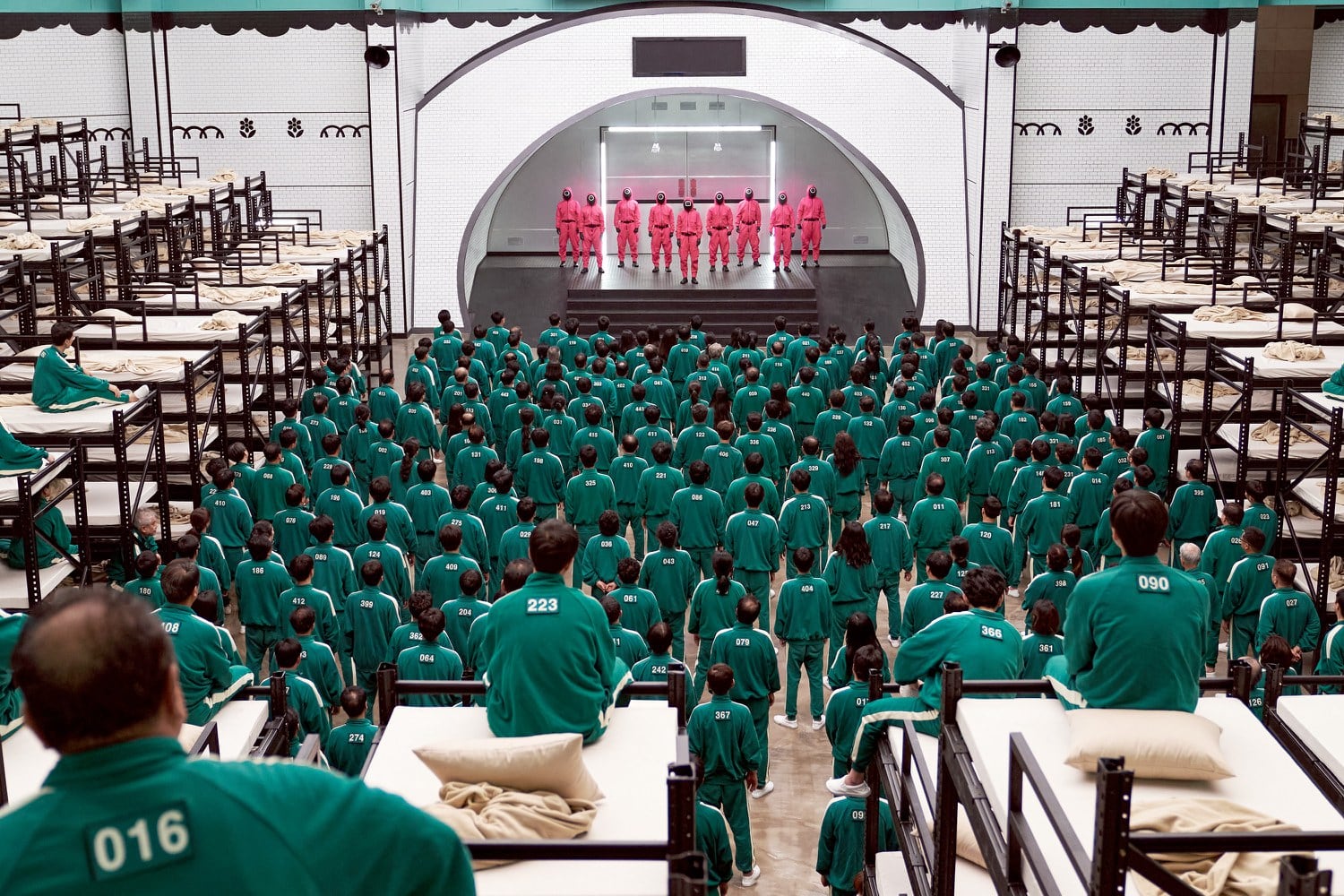
Distributing it can result in the death penalty. In one high profile case reported in 2021 by RFA, a man was sentenced to death for selling copies of the hit Netflix series “Squid Game.”

Offenders that merely watched foreign media – but did not distribute it – are usually given a lesser, but still harsh sentence in a labor camp. Parents can even be punished for the crimes of their children. Citizens can even be presumed guilty on tangential evidence – speaking like South Koreans or texting using South Korean spellings – habits they are presumed to have picked up from watching illegal videos from the South.
Despite the government’s efforts, including the passage in 2020 of the draconian Elimination of Reactionary Thought and Culture Law, which lays out specific punishments for foreign media-related crimes, North Koreans continue to tune in.
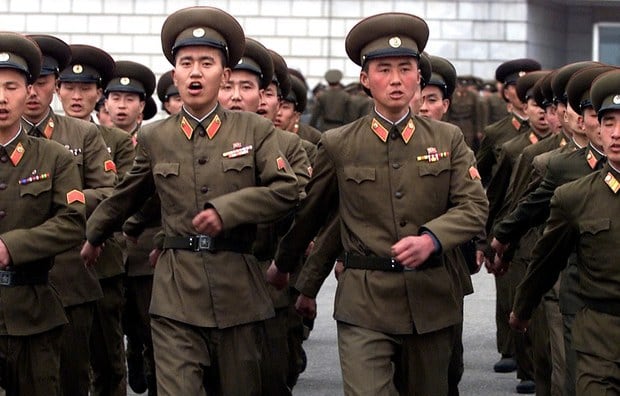
But members of the military are under even more scrutiny. A task force called the “109 Group” catches soldiers with surprise inspections, and after a soldier is caught, reports of punishments soon follow.
Because every North Korean spends seven to 10 years in the military after high school, the appetite for South Korean and U.S. media among soldiers is quite high, Yoshihiro Makino, a diplomatic correspondent for the Asahi Shimbun newspaper in Japan and a visiting professor at Hiroshima University, told RFA.
“With so many young people gathered in one organization, it is impossible to say that none of them are interested in that kind of culture,” Makino said.
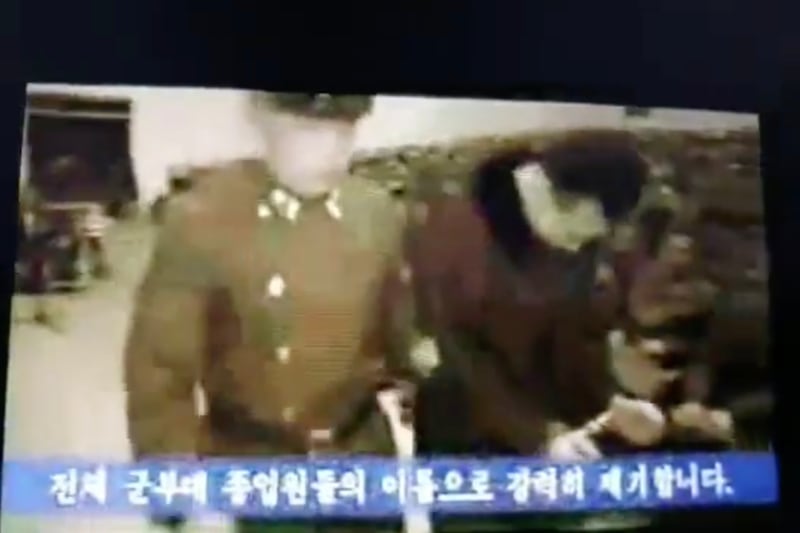
He added that it is not common in North Korea to see public accounts of military trials, because of the need to protect military secrets, so the fact that the proceedings are shown in the educational video indicates that authorities are concerned about the spread of South Korean culture, which they refer to as ideological contamination.
“Puppet-trash culture”
The educational video continues by showing several people in courtrooms being cuffed and led away as the narrator chastises foreign media watchers for being infected by the culture of the “puppets” of the United States – an oft-used pejorative referring to South Koreans. She calls these people “weeds of our society” and “trash of our era.”
She then blames the U.S. and South Korea for spreading “rotten capitalist and puppet-trash culture on a massive scale,” and complains about sanctions aimed at depriving Pyongyang of cash and resources that could be funneled into its nuclear and missile programs, calling them a U.S. “strangulation campaign.”
Against this backdrop she asks if watching foreign media could be anything but treason.
“Are not those infected by the political poison spread by the enemy a band of traitors acting as one with our principal enemies, and poisonous mushrooms that must be uprooted entirely?”
The narrator goes on to remind soldiers that they aren’t supposed to use civilian mobile phones, with the video showing examples of smartphones and flip phones that authorities confiscated.

“Soldiers performing individual duties, including drivers of passenger vehicles, purchased, watched, stored and distributed impure recordings through civilian mobile phones,” the narrator says. “In the end, these phones led them down the path of treason and counterrevolution, ruining their lives.”
A second video file obtained by RFA, containing footage of a later section of the educational video, discusses the case of Kim Kye Hyang, a military doctor punished for watching foreign media.
“The Party educated … and even appointed her as a military doctor in the revolutionary army,” an on-camera military official says. “But look at what happened. Watching impure recordings turned her, at the very beginning of her life, into an ungrateful and contemptible person.”
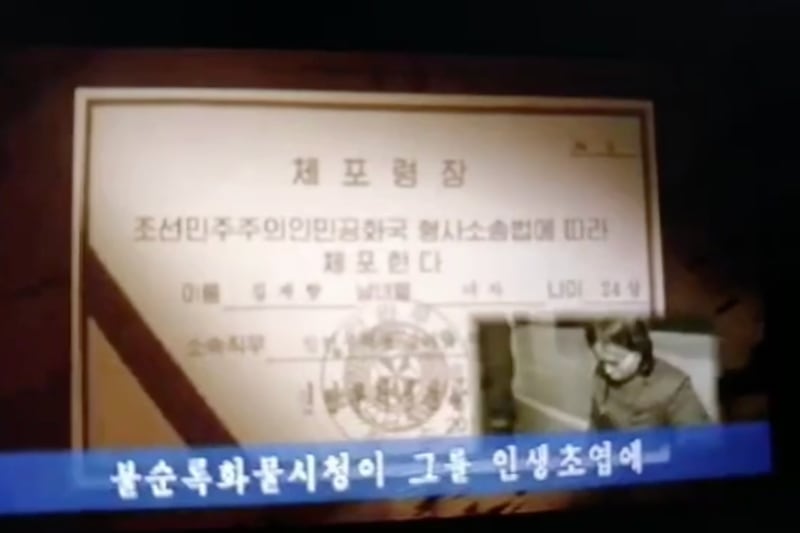
The official says her parents are now devastated and they cry often, wishing she had never been born. She denounces foreign recordings as a poison that wastes time, damages health and ruins the lives of offenders and their families.
The footage then shows a detained soldier writing a confession. Weeping, he says that watching foreign recordings “once or twice” gradually filled his mind with South Korean speech patterns and capitalist ideology.
“I deeply regret it,” he says while seemingly crying. With ominous music, the line is repeated several times with an eerie echo effect over a stopped frame of his anguished face.
A female soldier, clad in pink formal wear, appears next. She identifies the regretful soldier as Ju Chol Bom and says his case is proof that watching foreign media is “the path to ruining one’s life.”
The narrator also warns that such crimes are committed through personal connections and will eventually be exposed. The message appears to be that even if authorities do not detect an offense immediately, offenders can still be caught.
“Why do people realize the value of something precious only after losing it?” the speaker asks. “Ju Chol Bom’s fate clearly demonstrates that watching the enemy’s subversive footage, while knowing it is an act of treason and rebellion that dances to the enemy’s tune, is the very path to becoming the most foolish suicide victim in the world and ruining one’s own destiny.”
A male soldier then says that the offense deserves severe punishment and suggests that offenders not only harmed themselves, but others as well.

“Ju Chol Bom and several other offenders received sentences of five or more years of hard labor,” the male soldier says. “Because watching impure recordings is a serious crime, even a general amnesty is not permitted. In the end, with their own hands, they gouged out their own eyes.”
The loud, overarticulate voice of the narrator continues, implying that the actions of Ju and those like him dragged down others.
“But their eyes are not the only ones gouged out …”
The footage of the video abruptly cuts out.
Edited in Korean by Yi Yongin and in English by Eugene Whong.